PVS-Studio 8.01.110719.2351 Overview:

PVS-Studio 8.01.110719.2351 Crack is a tool for detecting bugs and security vulnerabilities in the source code of programs, which are written in C, C ++, C #, and Java. It works on 64-bit systems in Windows, Linux, and macOS environments and can analyze source code for 32-bit, 64-bit, and embedded ARM platforms.
PVS-Studio 8.01.110719.2351 License Key performs static code analysis and generates reports that help programmers find and fix bugs. PVS-Studio performs a variety of code checks and is also useful for finding typographical errors and copying and pasting. Examples of such errors are V501, V517, V522, V523, and V3001.
The main value of static analysis lies in its routine use so that errors are identified and corrected as soon as possible. There is no point in wasting 50 hours looking for bugs that can be found with a static scan. So, we’ll show you again – the main idea of static analysis is not to find a hidden bug the day before release but to fix dozens of bugs day after day.
The scanner can run overnight on the server and will automatically warn of suspicious code fragments. Ideally, these errors can be detected and corrected before they enter the version control system. PVS-Studio 8.01.110719.2351 Patch can be started automatically as soon as the file compiler has just changed. It works on Windows, Linux, and macOS.
PVS-Studio 8.01.110719.2351 Serial Key integrates with the Visual Studio 2010-2019 development environment. If you are using this IDE, just go to the PVS-Studio section of the menu and select “Check Current Projects”. However, this is often a more complicated process, requiring you to integrate PVS-Studio into even an exotic build system. The subject of such integration is too broad to be described here. You can find all the relevant information in our detailed documentation.
One more thing to note – PVS-Studio 8.01.110719.2351 Keygen for Windows and Linux provides special tools, which can collect build information during build. These tools allow a quick analysis of a project regardless of the construction system. You can quickly test the parser’s capabilities, without wasting time integrating it with make files or other build scripts.
PVS-Studio 8.01.110719.2351 Key Features:
- Simple and seamless integration with Visual Studio 2010-2019.
- Automatically scan individual files after recompiling them.
- Online reference guide for all diagnostic rules, available locally, on our website, and as a single .pdf file. Over 700 pages of documentation!
- Storage and load analysis results allow overnight checks – at night the analyzer performs the analysis and gives you the results in the morning.
- You can save scan results in HTML format with full source code navigation.
- Analysis can be performed from the command line: it helps to integrate PVS-Studio into the night build; new newspapers will be issued in the morning.
- High scalability: Supports multicore and multiprocessor systems with the ability to specify the number of cores to use; IncrediBuild support for distributed analysis.
- Interactive filtering of scan results (log files) in the PVS-Studio window: by diagnostic rule number, file name, keyword in diagnostic text, etc.
- Automatic checks for updates (in the IDE and when running builds overnight).
- Blame-notifier utility: This tool allows you to send email notifications to developers about bugs PVS-Studio found while running overnight.
- Analyze commit, merge, and drag requests – the analyzer can be configured to scan only changed files. This makes it possible to quickly and automatically analyze each commit in the version control system.
- A large number of integration options in projects developed under Linux and macOS.
- Mark as false alarm – Ability to mark code snippets to hide specific diagnostics on this row.
- Mass Suppression – Ability to hide all existing analyzer messages generated for old codes, so that the analyzer starts reporting 0 warnings. You can always come back to hidden messages later. This feature allows you to seamlessly integrate PVS-Studio into your development process and focus on errors found only in new code.
- Analyzer warning statistics can be viewed in Excel – provides a way to track error correction speed, the number of bugs found during a certain period, etc.
- Relative paths in the report file to display them on different machines.
- The compiler monitoring feature allows the analysis of projects that do not have Visual Studio files (.sln / .vcxproj) without the need to manually integrate with the build system; manual integration into any building system is possible if required.
- PVS-studio-analyzer – Linux compiler monitoring tool.
- Ability to exclude files from scanning by name, folder, or mask; to run a scan on files modified in the last N days.
- Integration with SonarQube – an open-source platform, designed for continuous analysis and measurement of code quality.
- Detection of security and safety weaknesses in the application lifecycle using Static Application Security Testing (SAST) methodology. PVS – Studio was included in the Forrester Research report “Now Tech: Static Application Security Testing, Q3 2020” as a SAST Specialist. This report is available by purchase or by subscription to Forrester Research.
What’s new in PVS-Studio 8.01?
(Released on 07-10-2026)
- PVS-Studio Java analyzer now complies with the OWASP Benchmark for Java, a benchmark for software vulnerability detection tools.
- The Java analyzer now supports projects that use JDK 25.
- The Go analyzer now supports projects that use Go 1.27.
- The PVS-Studio_Cmd.exe utility for the MSBuild project analysis can now save the project analysis configuration in the JSON analyzer report. The fullhtml report format now allows grouping analyzer messages by analysis configuration when an HTML report is generated using the PlogConverter.exe. Learn more about other report formats in the documentation.
- For the JavaScript and TypeScript analyzer, the max-old-space-size setting has been added to the pvs-settings.toml configuration file and to the pvs-js command-line utility. The setting limits the amount of memory used by the analyzer’s Node.js server.
- The PVS-Studio_Cmd.exe command-line utility now supports resolving dependency cache paths relative to the .pvsconfig configuration file. Learn more about the update in the documentation.
- The options for configuring diagnostic rules in the C and C++ analyzer have been extended. The types that the analyzer treats as cheap to copy can now be specified manually, and the analyzer behavior can be adjusted depending on the target platform. The V719 diagnostic rule now supports additional configuration options: ignoring default branches and small enum types, specifying individual values to ignore, and setting the maximum number of constants that can be ignored.
- In Plog Converter, the utility for converting and filtering reports, diagnostic rules can now be filtered by CWE codes and SAST identifiers.
- [Breaking change] The PVS-Studio installer for Windows now returns code 100 if Visual Studio plugin installation fails. The /skipVSIXInstallErrorCode flag was added to suppress the non-zero return code in this case.
- A cookie was created without enabling the ‘Secure’ attribute. This may lead to the exposure of sensitive data.
- Potentially tainted data is stored in an object that can be used as a source of trusted data.
- A cryptographically weak random number is used for sensitive data.
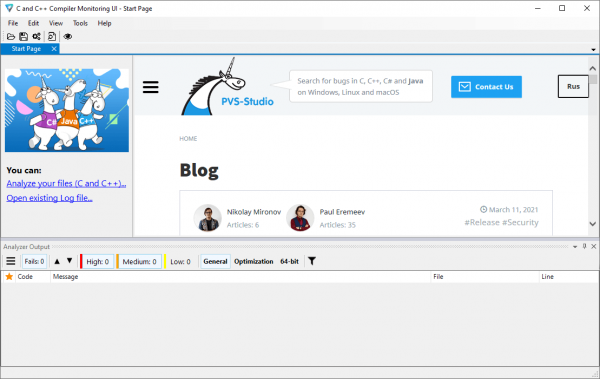
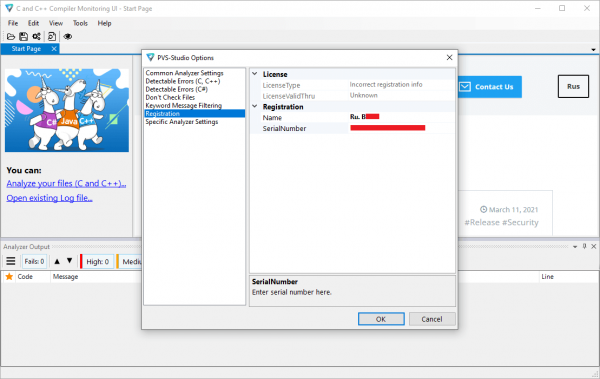
Screenshots:
How to install & activate it?
- Disconnect from the internet (Recommended).
- Extract and install PVS-Studio 8.01.110719.2351 by using setup.
- After the installation, don’t run the program or exit if launched.
- Copy the crack file to the installation directory and replace it.
- It’s done, enjoy PVS-Studio 8.01.110719.2351 Full Version.
PVS-Studio 8.01.110719.2351 Patch & Serial Key {Tested} Full Version Free Download from the links given below!