Details of Soluling Enterprise 1.0.1086:

Creating and maintaining multilingual software, documents, and data is made simple using the Soluling Enterprise Full Version localization tool. Include Soluling in your process of development. Soluling is compatible with your process regardless of whether you employ waterfall or continuous localization.
All the features you require to localize your projects are included in Soluling Enterprise Latest Version. It greatly facilitates localization. Soluling combines a command-line tool with a desktop application. More than 100 file formats are supported. Software, desktop apps, mobile apps, web apps, papers, online assistance, data files, and databases may all be localized with Soluling. It can be used for both document localization and software localization. The manner you use Soluling is up to you.
You often have an original file or database when you wish to localize something. Although strings and other localizable objects have been translated into the target language, you usually want your localized files and databases to keep the same structure as the original files. This is how Soluling operates.
Soluling Enterprise Full Cracked is a group of tools and services with all the functionality you need to swiftly localize your databases, documents, data files, and applications (software, desktop, mobile, and web). The localization process is advanced via soluling. Soluling has a sophisticated user interface. The most widely used file formats and database types can be translated with Soluling.
For quick, efficient, and correct translation, Soluling Enterprise Activated Version includes visual editors, spell checking, validation, terminology, translation memory, machine translation, and import/export capabilities. Additionally, it facilitates pseudo translation for rapid prototype localization. Localization standards are used in Soluling. There are hundreds of samples in Soluling. Soluling can be used into your development process.
You may also enjoy: Rusolut Platform Full Version
Why Choose Soluling Enterprise?
Soluling has the features you need:
- Scan your files locally on your build server or development machine — no need to send source code to a localization service or to give a localization service access to your repo.
- When scanning, Soluling completely decouples strings from your files, letting translators and developers work simultaneously.
- Soluling lets you localize everything: strings, layout, images, colors, etc.
- Soluling has visual editors that show the original and localized UI in real time.
- Soluling knows even the most complex resource formats. No need to limit only to a simple JSON.
- Soluling knows the project file formats. For example, instead of selecting dozens of .resx, .xaml, and/or .rc files you only select one: .csproj, .vbroj, .sln, .exe, or .dll file.
- During your build process, Soluling creates up-to-date resource files and injects translations into them.
- Output files that Soluling creates are ready to be deployed.
Soluling understands your file formats:
- Desktop projects: Visual Studio, .NET, .NET Framework, WPF, Windows Forms, Visual C++, Delphi, Qt, and more.
- Web projects: ASP.NET Core, ASP.NET Framework, Blazor, Angular, React, Vue, Django, Go, Ruby on Rails, PHP, Java, Magento, and more.
- Mobile projects: Android, iOS, UWP, Xamarin, FireMonkey, and more.
- Resource formats: ResX, XAML, Text, XML, JSON, YAML, INI, GetText/PO, TS, scripts, RC, and more.
- Document formats: Markdown, HTML, HTML Help, SVG, Word, Excel, PowerPoint, DITA, Help & Manual, and more.
- Databases: SQL Server, MySQL, PostgreSQL, SQLite, Access, InterBase, Firebird, and more.
- Other formats: TMX, SalesForce, SubRip, WebVTT, and more.
- 100+ supported formats.
Soluling increases your translation speed and quality:
- Machine translation: Amazon, DeepL, Google, Microsoft, ModernMT, and more. Get a candidate popup as you type.
- Translation memory with fuzzy matching. Get a candidate popup as you type.
- Terminology support with stemming. Soluling highlights those words that exist in the termbase. Click a highlighted word to get a translation and copy to the translation field.
- Pseudo translation, spell checking, import and export.
- Excellent support for grammatical numbers (e.g., singular and plural) and grammatical genders (e.g., male, female and neutral).
- Real-time and batch translation validation: Soluling automatically finds the errors as you type and can even fix them.
With Soluling, localization is easy:
- Complete list of the features.
- Support for build automation with flexible command-line tool.
- Excellent support for continuous localization.
- Internationalization API that extends native APIs.
- Hundreds of samples.
- Automatically import your existing translations. Switch from other tools easily.
- Excellent support.
Features of Soluling Enterprise 1.0.1086:
Continuous localization
Localization should be a continuous process that is carried out over the course of the product’s lifespan rather than a single activity that is completed after everything else. You can incorporate a continuous localization process into your development process by using Soluling. Localization can begin early in the development process and continue concurrently for the duration of the project. There are several approaches to translate your projects with Soluling. You can create and launch localized apps multiple times a day with Soluling.
Elegant user interface
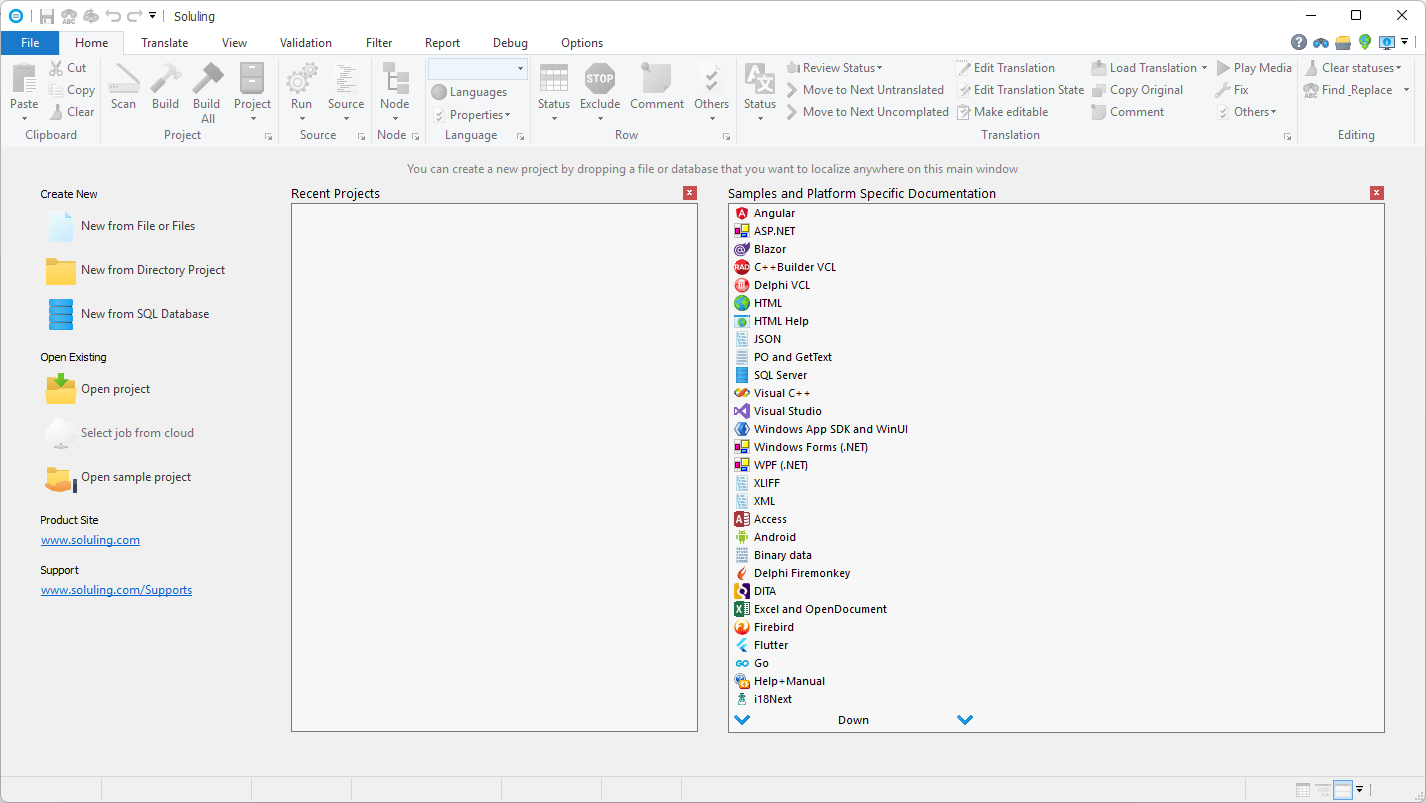
The most recent ribbon bar generation is used in Soluling. It functions and appears just like Excel’s user interface. Soluling is relatively simple to use if you are familiar with Microsoft Office applications. Soluling employs context-sensitive menus throughout the user interface in addition to the ribbon bar. To see what you can do for the chosen object, right-click on it. The start view, project tree, translation grid, and visual editors are all included in Soluling’s user interface.
Supports most formats
The majority of file and database types can be localized by Soluling. Applications for desktop computers, tablets, smartphones, the web, documents, data files, and databases can all be localized. We provide 100% support for every format. It implies that anything, including the user interface, strings, menus, graphics, audio, videos, subtitles, data, etc., can be localized by Soluling if your files or databases have been appropriately internationalized.
Visual editors, previews and/or screenshots
It is necessary to understand the context of strings that are part of the user interface when translating them. The string’s location on the user interface is the most significant context. For the majority of user interface components, including dialogs, forms, menus, and HTML pages, Soluling offers visual editors and previews. The platform’s actual code is used to implement Soluling’s editors and previews. This indicates that the element is 100% displayed in the editor exactly as it would be if you ran the application. A preview is available for a number of non-user interface elements, including source code data, HTML, XML, JSON, and INI.
Importing
Since you may sometimes already have translations, importing is a crucial component of a localization tool. For instance, you may already have localized files that you wish to import translations from. That is what Soluling can do. Additionally, it can import translations from over a dozen glossary/terminology or data formats, including Excel and TMX. Your current Sisulizer project files can also be converted using Soluling.
Exporting
You frequently wish to export data from Soluling so that it can be utilized in another program. XLIFF, TMX, Excel, and text files are just a few of the formats into which Soluling can export data. Data from translation memory and projects can be exported.
Pseudo translation
A system that mimics the target language is called pseudo translation. A translation is produced from the original string by a pseudo translator. Although the translation is not authentic, it employs the same script as authentic translations and incorporates other aspects of authentic translation, like string expansion. To test how your application and user interface function with different scripts and string lengths, you can utilize faux translation.
Terminology
A crucial component of localization is terminology. Utilizing terminology enhances the uniformity and quality of localization. Termbases and glossaries are used to give terms. There are one or more terms in each termbase. TBX, TNX, Excel, text, and database termbases can all be used with Soluling. Termbase files can be imported into Soluling’s termbase database or attached to Soluling. This database may be cloud-based (used by the entire team) or local (used by you alone). Soluling indicates every word in the source text that has a match in the termbases when you are translating your project. This facilitates your choice of appropriate translation.
Translation memory
Reusing translations is made easier by translation memory. It keeps track of your translations and can either automatically translate or recommend a translation if the same or a similar sentence reappears. When you choose a row with text that has a match in the translation memory, translation memory either translates or makes suggestions. Soluling generates a local translation memory by default, which is only accessible by you. Additionally, you can establish a common translation memory that is accessible to all team members. Third-party translation memories can also be used by Soluling. You can use translation memory in batch mode or in interactive mode while translating.
Fuzzy matching and segmentation
Finding strings that are similar but not identical is made feasible by a process called fuzzy matching. This allows for far greater reuse of already-existing translations. When importing translations and locating translations from translation memory, fuzzy matching is employed. Text paragraphs and strings can be divided into meaningful portions using a technique called segmentation. The two main components of Soluling’s translation memory are fuzzy matching and segmentation.
Machine translation
Sentences from one language can be mechanically translated into another using a technology called machine translation. Amazon, DeepL, Google, and Microsoft are just a few of the top cloud-based machine translation providers. All of them are useful to Soluling. Neural machine translation is used or has the potential to be used by all of these services. Additionally, Soluling uses Quality-Translate technology to obtain translations from multiple sources, evaluate them, and choose the best fit.
Spell checking and stemming
Even the most skilled writers occasionally make blunders. For this reason, Soluling has a spell-checking function. Everywhere translations are edited, including the translation grid, translation panel, terminology editor, and translation memory editor, it is utilized. Spell checking highlights incorrect words with a red underlining while you type. Soluling installs dictionaries for the most widely used languages by default. Later on, you can add other dictionaries and spell checkers. In order to identify better terminology matches, Soluling also use stemming.
Validation
Similar to spell checking, validation examines other translation-related problems rather than misspellings. The majority of the mistakes translators make when translating projects will be automatically detected by this. Spell checking validation additionally displays validation mistakes while you type.
Patterns: plurals, genders and select
There are just singular and plural forms in the majority of languages. This is not true for all languages, though. There is absolutely no plural in Asian languages. There is only one form for them. Three forms exist in the majority of Slavic languages: singular, plural, and in between (dual or paucal). Zero is treated as solitary and plural at different times. There are even four distinct variants for certain languages. There are six varieties of Arabic. Additionally, gender may call for two or more versions. You can enter language-specific plural, gender, and choose forms using Soluling’s sophisticated multi-pattern editor. We have developed a plural enabled library that you may utilize in your applications for platforms that do not have built-in support for patterns.
Internationalization API
Every programming platform has an internationalization API that enables you to develop localizable code. A resource string notion, interpolated strings or composite format, date, time, and numeric formatting are all present on the majority of platforms. Certain platforms have APIs for more sophisticated features including ordinal numerals, shortened numbers, and plurals and genders. Nevertheless, a few functionalities are absent from the majority of systems. The gaps are filled by our internationalization APIs. Additionally, we have added additional APIs like runtime language switch, file dialog format filter, and user interface testing. Features like the plural editor in Soluling make using those APIs more simpler. We have an open-source internationalization API.
Command-line tool
Although the Soluling program is incredibly user-friendly and powerful, there are some circumstances in which using an interactive application is not possible. Your makefiles or build process could be an example of this. We offer SoluMake, a command-line version of Soluling, for these uses. It can be used for import/export, scanning, and creating localized files. Furthermore, Soluling generates a result file that you may utilize in your build automation to see if any new translations, modified strings, or new strings have been imported.
Standards
No proprietary binary format is used by Soluling. The fundamental tenet of Soluling design was that we should support standards if they exist. Unicode, regular expressions, XML, JSON, XLIFF, TMX, TBX, SRX, base64/32/16, and many more are supported by Soluling.
User interface testing
Translations are typically longer than the original strings, which are frequently in English. This could lead to a number of problems with your user interface. You can check for potential truncations, overlapping, and out-of-bound controls in your user interface with a few lines of code. The user interface checker class is incredibly user-friendly and will immediately provide screenshots of the problems as well as a result file that includes all potential problems with your program. Furthermore, Soluling has the ability to insert hidden IDs inside the translated strings, allowing you to trace back each string during runtime.
Hidden id injections
This feature adds hidden IDs to every localized string. A localized string from an application can be traced back to a particular row in the Soluling project using this method.
Runtime language switch
There are situations when you might need an application that allows the user to switch the language at runtime. One language is used at the beginning of the application. Afterwards, the user can choose a different language from the list of available languages and create an application that will translate itself into that language. You only need to add a few lines of code to your application to generate this with Soluling.
Samples
A sample is typically more useful than dozens of pages of internet assistance. For this reason, every file or database format we support has at least one sample application or file. You may easily browse and open sample projects in the samples panel included in the start view.
Conversion from other localization tools
The majority of project files created with Sisulizer or Multilizer localization tools can be converted into the Soluling format by Soluling. Soluling may import translations from localized resource files if you used a different localization tool.
Soluling Enterprise 1.0.1086 Changelog:
(Released on 17-12-2025)
Bug Fixes:
- Delphi and .NET: Soluling did not detect ICU message format and even if you turned it manually on, Soluling did not parse it as ICU message unless the string id ended with Plural or Gender.
Information About the Software:
- Official Website: https://www.soluling.com/
- Size: 2.4 GBs
Screenshots (Tested):
Instructions to install & activate:
- Soluling Enterprise 1.0.1086 downloaded packages contain the setup for both 32-bit and 64-bit Windows operating systems (Choose according to your OS).
- Disconnect from the internet and also pause your Antivirus momentarily as the medicine file will be detected as a threat to your Windows (But it is safe and tested by TOPKEYGEN).
- Now extract the package using WinZip or WinRAR and install Soluling Enterprise 1.0.1086 using setup.
- After the installation is done, don’t launch the program.
- Copy the crack files to the installation directory and replace them.
- It’s done, Enjoy Soluling Enterprise 1.0.1086 Full Version!
System Requirements:
- Operating systems: Microsoft Windows 7, 8, 8.1 or 10 (32-bit or 64-bit).
- Processor: Intel i3 or higher.
- RAM: 4 GB or more.